
The energy storage landscape has moved far beyond simple kilowatt-hour (kWh) and megawatt (MW) ratings. For professionals managing multi-million-dollar infrastructure from telecom networks to massive EV charging hubs the specifications sheet is the playbook for asset success. Understanding the metrics that matter in energy storage means cutting through marketing noise and focusing on the nuanced figures that define long-term financial viability and operational uptime. In this space, we’re not just buying batteries; we’re investing in performance guarantees.
This article cuts straight to the core figures. We’ll unpack the critical performance indicators (KPIs) that dictate everything from real-world response speed to ultimate return on investment (ROI), ensuring you can compare systems not just by their upfront cost, but by what they will deliver over the next decade. Let’s dive into the metrics that separate a high-performing asset from an operational liability.
Core Technical Metrics for Power and Speed
When evaluating energy storage, your first task is to define the system’s character. Is it a sprinter, built for short bursts of high-intensity power, or is it a marathon runner, designed for long-duration energy delivery? Two foundational metrics establish this identity.
What is Power Density vs. Energy Density?
Think of an energy storage system as a water tank. Energy density (measured in Wh/kg or Wh/L) is how much water the tank holds. It tells you the total runtime. In contrast, power density (measured in W/kg or W/L) is the size of the hose pipe delivering the water. It tells you how fast the system can push that energy out.
The Power-to-Energy Ratio in System Design is key. A high ratio (e.g., 2 MW / 1 MWh = 2-hour duration) indicates a system optimized for power applications like frequency regulation or instantaneous demand spikes. Why Power Density is Critical for Fast-Response Applications is simple: these systems must deliver enormous power instantly to stabilize a grid or support critical equipment. For industrial BESS performance, where milliseconds matter for power quality, power density is non-negotiable.
The Importance of C-Rate and Response Time
The C-Rate is the most direct measure of a system’s speed and stress tolerance. It is a calculation of the charge or discharge current relative to the battery’s capacity. A 1C rate means a full charge or discharge in one hour. Calculating C-Rate for Ultra-Fast Charge/Discharge Cycles is crucial for applications like EV fast charging metrics, where a 3C or 5C capability is needed to replenish large battery packs in minutes, not hours. However, pushing a system to its maximum C-Rate often increases heat and degrades lifespan a critical trade-off to watch.
Defining and Measuring Millisecond-Level Response Time is vital for Grid services BESS performance. Response time is the delay between the external signal (the call for power) and the system’s ability to deliver the requested output. For frequency regulation, this must often be near-instantaneous (sub-100ms). Don’t rely solely on the battery’s response; demand the total system response time, which includes the Power Conversion System (PCS) and the Energy Management System (EMS).
Reliability and Longevity Metrics for Maximizing ROI
Uptime and longevity are where the true financial value of a storage asset resides. If a system promises a 10-year lifespan but fails its performance target in year five, the entire financial model collapses. Understanding degradation is the bedrock of intelligent procurement.
Understanding Cycle Life and Calendar Life
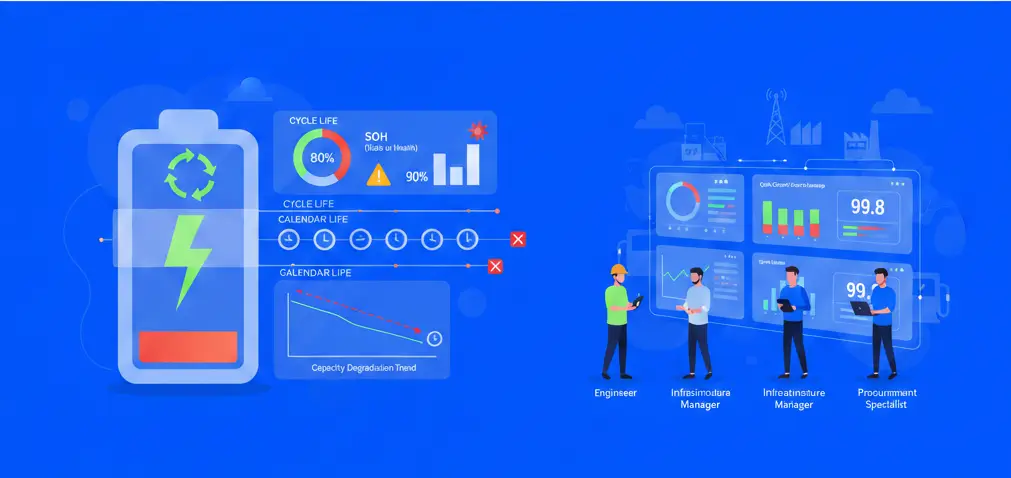
Cycle Life is the number of full charge-discharge cycles a system can perform before its usable capacity falls below a specified threshold, often 70% or 80% of the original rating. Calendar Life is the number of years the system is expected to last, regardless of usage. Batteries degrade even while sitting idle. For assets in telecom backup power reliability, which sit fully charged for long periods, calendar life often becomes the dominant factor.
The difference between Stored Life and Operational Life is huge. A 20-year calendar life on paper means nothing if the system’s operational schedule requires thousands of deep, high-stress cycles. Be aware of How Testing Protocols Affect Reported Cycle Life Figures. A vendor quoting 15,000 cycles at a shallow 50% Depth of Discharge (DOD) is not equivalent to a vendor quoting 10,000 cycles at a deep 90% DOD. Demand transparent testing data that matches your expected operational profile.
How State of Health (SOH) and Depth of Discharge (DOD) Impact Lifespan
Depth of Discharge (DOD) is the percentage of a battery’s total capacity that has been discharged. Using 80 kWh out of a 100 kWh battery is 80% DOD. We are always Calculating Usable Capacity Based on System DOD Limits because discharging a battery too deeply accelerates degradation. High-quality systems often employ a battery management system (BMS) to enforce a safe, narrow DOD window to protect the asset.
The State of Health (SOH) is the system’s health report card, showing its current capacity relative to its original capacity. SOH allows for Predictive Maintenance Using SOH Tracking. By monitoring the SOH trend, managers can accurately forecast when a system will hit its end-of-life (EOL) warranty threshold, allowing for planned component replacement, rather than dealing with costly, unexpected failures. This proactive approach is vital for critical infrastructure.
Operational and Economic Efficiency Metrics
Once performance and longevity are quantified, we turn to the financial metrics that govern profitability. These figures move beyond the initial capital cost to measure the long-term, per-unit cost of energy delivered.
Why Round-Trip Efficiency (RTE) is Not the Only Efficiency Metric
Round-Trip Efficiency (RTE) is the percentage of energy put into the system that you get back out. If you put in 100 kWh and get 90 kWh back, your RTE is 90%. While critical, RTE is an aggregate figure. The Impact of Auxiliary Consumption (Thermal Management) is often overlooked. If your system is in a hot climate, the energy needed to run the cooling system (HVAC) is a continuous energy drain an auxiliary load that reduces real-world RTE.
Always distinguish between cell-level, DC-level, and AC-level efficiency. System vs. Cell-Level Efficiency Measurement is key. The number on the cell data sheet is theoretical. The AC-level RTE, which includes all losses from the battery, through the PCS, and into the transformer, is the only number that impacts your balance sheet. For peak shaving efficiency, every percentage point of RTE improvement directly translates into thousands of dollars in annual savings.
The Ultimate Procurement Metric: Levelized Cost of Energy (LCOE)
The Levelized Cost of Energy (LCOE) is the true north for system economics. It is the average total cost of building, operating, and replacing the system, divided by the total energy it delivers over its lifetime. It provides a single, dollar-per-kWh figure that allows for an apples-to-apples comparison between vastly different technologies.
LCOE is calculated by Breaking Down Capital Expenditure (CapEx) vs. Operational Expenditure (OpEx). CapEx is the upfront cost (hardware, installation). OpEx includes ongoing costs like maintenance, monitoring software, and site rent. The formula ensures you are Incorporating Degradation Rates into LCOE Calculation correctly. A system with a lower CapEx but a shorter cycle life and high degradation may have a higher LCOE than a system with a higher CapEx but a longer, more reliable service life. This highlights the importance of evaluating the Cost of Usable Capacity vs. Nameplate Capacity, as only the usable, delivered energy matters to the LCOE calculation.
Application-Specific Key Performance Indicators (KPIs)
The best metric is one that directly relates to your specific business goal. Different applications demand a focus on different KPIs.
KPIs for Telecom and Industrial Peak Shaving
In industrial and network settings, the focus shifts to reliability and utility cost avoidance. The most critical KPI for continuous operation is Backup System Uptime and Availability Percentage. In Telecom backup power reliability, this is often guaranteed by contract. The Power Quality Metrics (such as harmonic distortion and voltage regulation) are critical for protecting sensitive equipment. For industrial facilities running Peak shaving efficiency programs, Production-Normalized Energy Intensity the kWh required to produce a single unit or widget provides a clear, actionable metric for cost control.
Metrics for EV Fleet Fast Charging Infrastructure
For EV fleets, time is money and system availability is king. Key EV fast charging metrics center on throughput and reliability. Charger Uptime and Network Connectivity Percentage must be near 100%. Grid Peak Load Reduction (kW) is the metric used to confirm the BESS is avoiding utility demand charges, the primary financial driver for this application. Finally, the Vehicle Turnaround Time (VTT) how quickly a vehicle can return to service is the ultimate measure of operational success.
How to Select the Right Performance Metrics for Your Project
Selecting the right BESS comes down to matching its performance profile to your operational needs. The best system for a microgrid demanding millisecond stability is completely wrong for a solar shifting project that needs 8 hours of duration.
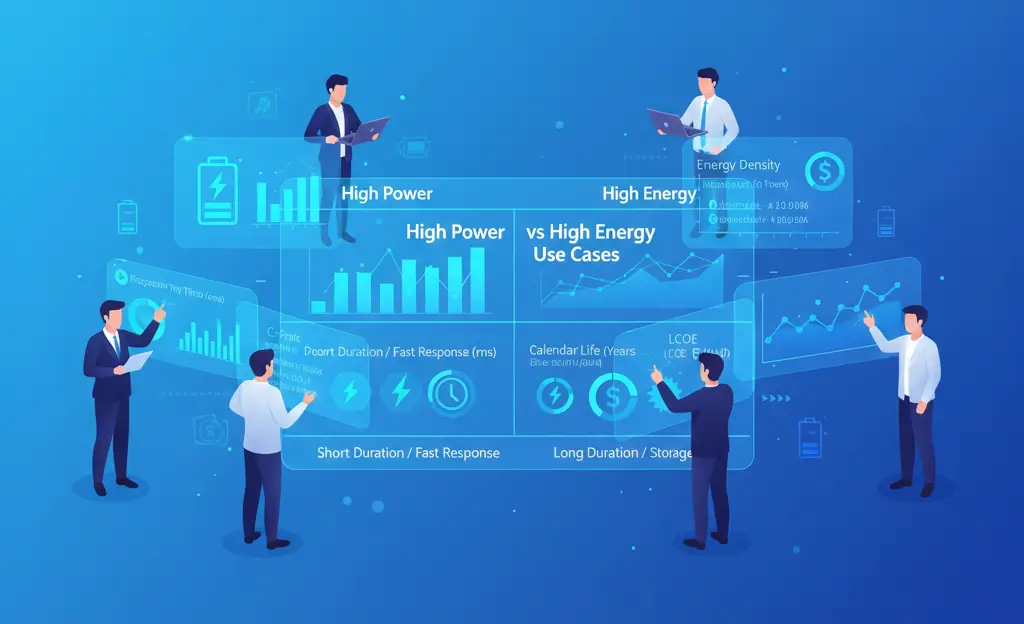
We must begin by Aligning Technical Needs with Financial Targets. Use a High Power vs. High Energy Use Case Matrix to guide your initial screening. If your goal is frequency regulation or high-rate charging, prioritize power density, C-Rate, and response time. If your goal is multi-hour energy shifting or backup, prioritize energy density, calendar life, and low LCOE. Always prioritize Prioritizing Reliability for Critical Infrastructure. For telecom and hospital backup, the lowest LCOE system is the one that never fails.
FAQs
How does ambient temperature affect a system’s SOH and RTE?
High temperatures accelerate SOH degradation and increase the need for cooling, which significantly lowers the real-world RTE due to auxiliary consumption.
What is the generally accepted benchmark for energy storage Round-Trip Efficiency?
For modern, large-scale lithium-ion systems, AC-coupled RTE is typically 85–90%.
How do you calculate the Levelized Cost of Energy (LCOE) for a high-cycle application?
You calculate the net present value of all costs (CapEx + OpEx + replacement) and divide it by the total discounted, usable energy discharged over the project’s lifetime.
Beyond cycle life, what is the most critical metric for long-term warranty validation?
The most critical metric is the SOH (State of Health) guarantee at the warranty’s expiration point, usually 70–80% of original capacity.
Conclusion
The shift from treating energy storage as a simple component to seeing it as a critical infrastructure asset depends entirely on expert metric analysis. By focusing on reliability indicators like SOH and cycle life, alongside financial measures like LCOE, you move beyond marketing hype. Truly successful projects prioritize application-specific KPIs whether it’s power density for fast charging or RTE for industrial BESS performance. Understanding and demanding transparency regarding The Metrics That Matter in Energy Storage is the single most important step toward maximizing system uptime and securing long-term financial return.