
If you manage a commercial facility or an industrial fleet, you’ve likely hit a wall: you need to electrify your vehicles, but the local power grid just can’t keep up. It’s a classic square peg in a round hole problem. You might have the chargers installed but do you have the power to run them reliably? This is exactly where choosing the best microgrid controller for EV charging becomes critical.
The solution isn’t just adding more wires; it’s deploying a smarter brain for your energy system. Enter the microgrid controller. The best microgrid controller for EV charging intelligently balances surging fleet charging demands with limited grid capacity, ensuring you don’t overspend on energy or risk downtime. Acting as the essential “conductor” of your energy orchestra, it optimizes costs, manages power flow, and guarantees your electric fleet is charged and ready to roll when you are.
What is a Microgrid Controller?
Think of a microgrid controller (MGC) as the central nervous system of your local power network. In simple terms, it is a smart computer that talks to all your energy assets your solar panels, battery storage, diesel generators, and the utility grid at the same time.
Its main job is orchestration. Instead of these systems working alone, the controller makes them work together in real-time. It decides when to store energy, when to use it, and when to pull from the grid. This ensures your system stays stable and efficient, no matter what is happening outside.
For a deeper dive into how we handle this orchestration, you can explore our approach to microgrid energy management and see how different assets come together seamlessly.
Why Commercial EV Charging Demands Intelligent Control
Plug-and-play works for a toaster, but not for a fleet of electric trucks. Standard grid connections simply weren’t built to handle the massive, sudden power draws that come with large-scale EV fleet charging. Without intelligent control, you face three major “pain points.”
Mitigating Demand Charges
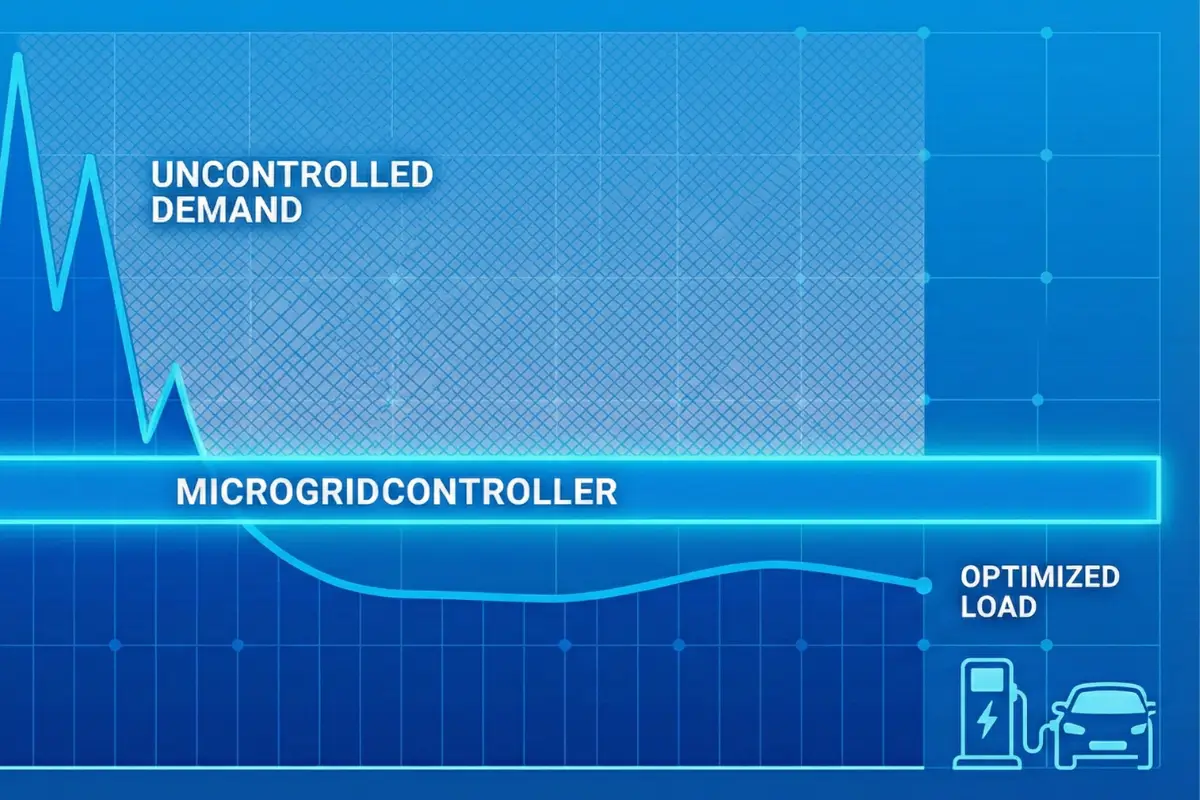
Utilities often charge fees based on your highest usage spike in a month. If five delivery trucks plug in at 5:00 PM when electricity is most expensive, your bill could skyrocket instantly. An intelligent controller prevents this by “smoothing out” these spikes, ensuring you never cross that expensive threshold.
Overcoming Grid Capacity Limits
Many facilities are capped on how much power they can draw. If you try to charge too many vehicles at once, you risk tripping breakers or damaging infrastructure. A controller acts like a traffic cop, strictly managing the flow so you can charge more vehicles without needing expensive upgrades to the utility lines.
Ensuring Fleet Uptime
Grid outages are a reality. For a logistics company, a blackout means trucks don’t charge, and deliveries don’t get made. That is operational paralysis. A smart controller ensures your system can switch to backup power instantly, keeping your chargers running even when the rest of the block goes dark.
Critical Features of the Best Microgrid Controllers
Not all controllers are created equal. The best ones for EV charging go beyond simple monitoring; they actively manage the chaos. Here are the technical capabilities you should look for.
Dynamic Load Management (DLM)
This is non-negotiable. DLM balances your charger output in real-time against your building’s other needs. If your factory machinery turns on, the controller automatically lowers the power to the EV chargers for a moment to prevent an overload. Once the machinery stops, the chargers speed up again.
Interoperability & Standards
You never want to be locked into one brand. Superior controllers speak “universal languages” like OCPP (Open Charge Point Protocol) and Modbus. This means you can mix and match different charger brands or battery types, and the controller will still be able to talk to them perfectly.
Islanding Capabilities
Resilience is key. “Islanding” is the ability to seamlessly cut the cord with the utility grid and run independently. During a blackout, the controller isolates your facility and powers it using your local batteries and solar. This is the core of reliable off-grid power systems, ensuring your operations never skip a beat.
Predictive Forecasting
The best controllers use AI to look into the future. They analyze weather forecasts to predict how much solar power you’ll generate tomorrow, and they learn your fleet’s schedule to know when demand will peak. This allows the system to charge batteries ahead of time, prepping for the rush before it even happens.
Strategic Benefits for Facility Managers
For decision-makers, the technology is cool, but the business results are what matter. Here is how a microgrid controller pays for itself.
OpEx Optimization
Energy is a variable cost you can control. By using strategies like industrial peak shaving, the controller reduces your Total Cost of Energy (TCO). It intelligently switches to battery power during expensive peak hours, saving you massive amounts on utility bills without you lifting a finger.
Sustainability Reporting
Investors and customers care about green energy. A good controller tracks exactly where your electrons come from. You can prove that “80% of our fleet was charged by solar power this month.” This data is gold for ESG (Environmental, Social, and Governance) goals and earning carbon credits.
Scalability
Your fleet will grow. A robust controller allows you to add more chargers or batteries later without ripping out the whole system. It’s “future-proofed” infrastructure that grows alongside your business needs.
How to Select the Right Controller for Your Facility
Selecting a controller is a big commitment. It’s like choosing the operating system for your business. Follow these steps to get it right.
Audit Current and Future Loads
Don’t just buy for today. You need to accurately size the system for the fleet you plan to have in five years. Calculate the energy needs of your future electric trucks and ensure the controller can handle that volume of data and power flow.
Evaluate Vendor Agnosticism
Avoid walled gardens systems that only work with one specific brand of hardware. If a vendor says their controller only works with their batteries, walk away. You want a system that is open and flexible, giving you the freedom to buy the best hardware at the best price in the future.
Assess Cybersecurity Standards
This is critical infrastructure. If your controller gets hacked, your fleet stops moving. Ensure any vendor you consider meets strict industrial security protocols, such as IEC 62443. This standard ensures the device is built to resist cyberattacks, keeping your physical assets and your data saf
Future Trends in Microgrid EV Integration
The technology is moving fast. Here is what is coming next to make your investment even more valuable.
Vehicle-to-Grid (V2G) Readiness
Soon, your trucks won’t just consume power; they will store it. V2G technology allows parked EVs to push energy back into the building or the grid. Your fleet becomes a massive mobile battery, earning you money by selling power back to the utility when prices are high.
AI-Driven Automation
Controllers are getting smarter. Self-learning algorithms are starting to optimize dispatch strategies without any human setup. They will watch your facility for a few weeks, learn the patterns, and then automatically tune the system to save the maximum amount of money, all on their own.
FAQs
What is the difference between a BMS (Battery Management System) and a Microgrid Controller?
A BMS lives inside the battery pack and focuses on safety keeping the cells balanced and preventing overheating. A Microgrid Controller lives above that, managing the entire facility. It tells the battery (and the BMS) when to charge or discharge based on costs and building needs.
Can a microgrid controller work with existing diesel generators?
Yes. A good controller can integrate your legacy diesel generators. It can start them automatically during a long outage or use them to top off batteries if solar production is low, ensuring you use fuel as efficiently as possible.
How much can a microgrid controller save on demand charges?
While it varies by location, facilities often see reductions of 20% to 40% on their energy bills. By shaving off those few critical peaks each month, the savings can pay for the system in just a few years.
Is a microgrid controller necessary if I only have a few EV chargers?
For just one or two passenger cars? Probably not. But if you have heavy-duty industrial vehicles or a growing fleet where charging must happen simultaneously, a controller becomes essential to avoid tripping breakers and incurring penalties.
Does the controller require a constant internet connection to function?
No. A high-quality “Edge” controller will continue to manage your local power and safety functions perfectly even if the internet goes down. You might lose remote visibility for a while, but the lights (and chargers) will stay on.
Conclusion
As we move toward an electrified future, the gap between what the grid can provide and what your fleet needs will only widen. A microgrid controller bridges that gap. It transforms your facility from a simple consumer of power into an intelligent, resilient energy hub. By investing in the right control system today, you aren’t just saving money on bills you are securing the operational future of your business.